Wednesday, December 31, 2008

2008-What a Wonderful Year!


Yellow Lady Slipper


Wow! I can't believe tomorrow is January 1st. And, yours truly will be another year older- and wiser, I hope. 2008 was a tremendous year for me and I believe 2009 will be just as exciting!


Little Floating Bladderwort
Monarch Ovipositing in April

Hognose Snake. Photo by John Howard.

I thought I would end the year with a big thank you to all my co-workers, friends and family. I think you all truly helped make this a great year. I witnessed so many cool things. Life birds, plants, insects, butterflies, dragonflies and with such great company. I think every outing I went on was a blast. I honestly cannot remember a trip that stunk. Even the ones I struck out on what I was looking for. The company always made up for it. Simple hikes on the property, to out and out quests for rarities, all have been great!

Green Salamander

Hummingbird Moth on Common Milkweed

At first I thought I would list everyone, but I am so terrible at remembering, I would surely forget someone, and I wouldn't want to do that. But you all know who I have been out exploring with. So, here it is:
Thank You!! Thank You!!!Thank You!!! Thanks a million!!!


Spider and Wasp interaction. Photo By Jim McCormac.

Wheel Bug on False Sunflower
Black Widow

Harvester Butterfly on Horse Dung

Fishing Spider

Crested Coral Root Orchid

Two special honorable mentions- One to my sister, Joyce. She has put up with muddy boots, help me wash mud encrusted pants and Keen's, and encouraged my exploring. The other, to my brother, Charles for getting me the awesome camera to help me capture many of these images. Thank you so much!

Happy New Year, Everyone!!!!


Yellow-fringed Orchid

Pink Lady Slipper Orchid


Devil's Urn Fungus with Tiny Spiders Inside

Doe near Side of Road at Eagle Creek

StumbleUpon

Thursday, December 25, 2008

A Christmas Present from Nature

My sister, Joyce, and I were headed across State Route 741 near Lebanon, OH around 4:30 pm today and witnessed the most amazing sight. We noticed the clouds near the sun were lit up with color, blending from rich orange to yellow to a pale green and a hint of purple. It looked like a short rainbow, but it was not raining. We found out later that this strange atmospheric anomaly is called a parhelion or, the word I prefer, sundog.


Sundogs are formed by reflection or refraction of sunlight by ice crystals found within cirrus or cirrostratus clouds. These are the thin wispy clouds you sometimes see in the sky that seem to go for miles. Sundogs normally occur, but not always, when the sun is low in the sky, like at sunrise and sunset. The ice crystals within the clouds act as prisms breaking up the light into the different wavelengths producing the spectrum of colors. When the light hits the prism-shaped ice crystals, the white light is slowed down causing it to separate into the different colors. This process is called dispersion. If you want to learn more, here is a great site that goes into all the physics behind sundogs. The link at the bottom of this sites page explains how they are formed.

I didn't have my camera with me, but I pulled a few images from Wikipedia. I have seen only one sundog before. This was my sister's first.


I was so glad to share this unexpected and beautiful event with my sister on Christmas Day!StumbleUpon

Wednesday, December 24, 2008

Sky Watch-December 24th, 2008

It's Christmas Eve and I am in pain because I ate tooooo much! I am sure I am not the only one suffering from the evils of well-meaning relatives who enjoy stuffing others full of food. Since many of you may not be able to handle a hike, but can surely waddle outside and look up, here is what the night sky should look like. You can see Mercury, Venus and Jupiter if you look toward the Southwest around 40 minutes after sunset. Get outside for a bit and enjoy!

StumbleUpon

Saturday, December 20, 2008

Long-tailed Ducks

Today I participated in the Northeast Indy Christmas Bird Count here in Indianapolis. The weather was quite brisk, but that did not deter the birds.


We had a great time finding all kinds of interesting birds. Surprisingly, we had over a thousand robins in our count circle today!

We found Greater White-fronted Geese, Northern Harriers, Red-shouldered Hawks and, my favorite, five Short-eared Owls at the Mt. Comfort Airport. You can read the prior post to find out a bit about "shorties".


And the find of the day? Two Long-tailed Ducks, Clangula hyemalis! Long-tailed Ducks are not a common visitor to Indianapolis. These are sea ducks, usually found in much deeper waters. We found these creatures at Geist Reservoir.

This is a photo my friend Cheryl Harner took a few days ago at the Huron City Pier in Ohio of a female Long-tailed Duck. Just take this pic and double it, and you have the view we had today. Two females in winter plumage. These ducks truly enjoy diving, so we had to keep watching for them to surface. Up they would pop, then like miniature Houdinis, they would vanish below the surface.


A cool fact is they are able to dive as deep as 200 feet in order to forage under the water. Wow!


Male Long-tailed Duck in winter plumage. Photo by Arthur Grosset from the Patuxent Wildlife Research Center.


The common name of the duck comes from the extremely long feathers that make up the tail of the male drake. Above is a picture of the male in winter plumage. Such a striking animal. A better look at the male bird swimming can be found at Internet Bird Collections.


The Long-tailed Duck graces the Federal Duck Stamp for the 2009-2010 season. A little known fact is that 98 cents of every dollar from duck stamp sales go to purchase or lease wetlands. This is critical for many duck species' survival. If you love ducks, I strongly urge you to support this wonderful program by buying your own duck stamp, today.

StumbleUpon

Thursday, December 18, 2008

Goose Pond/Hawthorn Mine CBC and Short-eared Owls

Yesterday, Dec. 17th, I participated in the Goose Pond/Hawthorn Mine Christmas Bird Count. The preliminary results turned up 103 species on a very icy day! Don Gorney and I lucked out and had a section with lots of rarities in Hawthorn Mine. Don even found a Black Scoter, a real gem for the area.


I love to bird in this area, especially in the winter. My favorite bird is found there-the Short-eared Owl, Asio flammeus. We saw about 30 of them yesterday. I have seen hundreds over the years, but I never tire of seeing shorties.
Shorty courtesy of Great River National Wildlife Refuge


I had a fairly good shot of a Shorty, but somehow I was struck by the photo gremlins. Usually the pics show up on my photo card. This time it ended up on my camera's internal memory and dang it if I can't find my cord. If any of my friends or family find my cord to my camera, I will buy you lunch! So I am using public domain photos, for this post.


Short-eared Owls are the coolest birds. I love their eyes, piercing bright yellow orbs encircled with black. They look like Tammy Faye did their make-up. I also love their ability to completely disappear. They can hunker down in the grass, so well-camouflaged, you could walk right by and never even detect them. There is an amazing photography book by Art Wolfe called Vanishing Act. One of my favorite photos has a Short-eared Owl that is totally concealed in grasses.

Short-eared owl courtesy of Lacreek National Wildlife Refuge

Short-eared Owls do not have a traditional "hoot". They bark, a sort of "Nyeep", which reminds me of a Monty Python skit. I love the cute little barks that they utter while they float effortlessly over the grasses looking for tasty vole snacks. Snausages!


The Goose Pond/Hawthorn Mine are located approximately 2 hours southwest of Indianapolis near the towns of Linton, Dugger Sandborn and Pleasantville. If the weather is fairly mild, the short-eared owl show will probably be showing until late January.StumbleUpon

Saturday, December 13, 2008

Purple Finches

Today I went birding at Eagle Creek Park with my pal Don Gorney. We were searching for waterfowl and White-winged Crossbills. While we didn't turn up any crossbills and the waterfowl pickings were slim, we did turn up two different flocks of Purple Finches and were able to watch them for quite a while.


For comparison, on top is a male House Finch
and a male Purple Finch on the bottom, captured
by my photowizard friend, John Howard.
"Purple" Finches are really more of a red raspberry color than a true purple. Male Purple Finches can be confused with male House Finches, but House Finches have a brighter red color with a tinge of orange. Also, the flanks and belly of a male House Finch is more heavily streaked with brown, while the Purple Finch has more raspberry color on the flanks. The back of a male Purple Finch has a raspberry wash, while the back of a House Finch does not. The Purple Finch is a bit chunkier in shape and a bit larger than the House Finch. The face of the male Purple Finch is more colorful and the ear patch is red, while the House Finch has a brownish ear patch. The beaks are slightly different. The culmen or upper beak of the House Finch is slightly curved while the beak of the Purple Finch is more conical and slightly larger. This feature is hard to detect unless the bird is close or you have really good binoculars.

Female House Finch on the top, female Purple Finch on the bottom. Photos from Flickr.
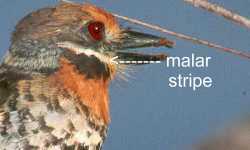
Females are a bit trickier. The one solid feature is the dark ear patch with the pale stripe above and below on the Purple Finch that can easily be seen from a distance. The Female Purple Finch has a distinctive brown malar stripe or moustache. Again, Purples are a bit chunkier. Beaks of females are similar to males. The female Purple Finch has a striped back, while the back of the House Finch is more uniform brown. The female Purple Finch has a breast that is more spotted in appearance than that of the House Finch which has thinner streaks.

I had commented that I don't see too many male Purple Finches. Don gave me a good explaination. Young male birds look a lot like females; they have little if any red coloration. If each pair has an average of four young, then that would produce one prominent male and five female-type birds. So roughly only 17 percent of the population is an obvious male.

The flocks of Purple Finch we observed were eating the long, thin paddle-like seeds of ash trees They were scarfing them down like teenage mutant ninja turtles devour pizza. These seeds must be pretty darn tasty. They were also enjoying the berries of dogwoods.

Tomorrow starts Christmas Bird Counts. Keep your eye out for this beautiful little bird!
StumbleUpon

Wednesday, December 10, 2008

Winter Blues

One of the things I don't like about winter here in Indiana is the lack of the beautiful color that accompanies the other seasons. No spring or summer flowers. No fall leaves. No brightly colored warblers. Bummer, bummer, bummer. So today I am going to show some "blue" images to help lighten up the winter doldrums.

Eastern Bluebird eggs, Sialia sialis, in one of our nest boxes. We had quite a few successful broods this year with lots of little ones gracing our park with their antics.

Wild Iris, Iris versicolor, from our wetland at Southeastway. We only have a few scattered throughout the wetland and around the pond, so I always look forward to finding them in May.

Virginia Bluebells, Mertensia virginica, can be viewed at Eagle Creek Park, Town Run Park, Holliday Park and Southwestway Park. Such a delicate flower and a real delight to see a whole hillside covered with these beauties.

Butterfly Pea, Clitoria mariana, is a rarer plant from Shawnee State Forest in Southern Ohio. It has such a unique shape to the blossoms and it forms a pea-like seedpod.

Cuckoo Wasp, from the Chrysis genus, a pretty common summer and fall visitor. I love the iridescence of this very docile creature. Depending on the light, it would shimmer green or bright blue as it moved about in my hand.
Downy Gentian or Prairie Gentian, Gentiana puberulenta, has threatened status in Indiana and endangered status in Ohio. Because there are collectors out there, lurking, I will not give the location where this is found. I love its "Pepsi can blue" color. Such a deep blue, you just don't find this very often in nature.

StumbleUpon