Wednesday, March 25, 2009

Squirmin' In the Rain

My first-ever blog. I feel so viral! I was excited when Janet invited the naturalists over here at Holliday Park to join in the fun, but was having a hard time getting inspiration for a post. Then, this morning when I stepped outside, it hit me! Then it hit me again! Right on the head this time! After a few weeks of unseasonably warm and dry weather in central Indiana, we were finally getting a good rainstorm. I donned my raincoat to avoid any more cold drops down the neck, and quickly realized that I was not the only creature enjoying the change in weather. Earthworms were everywhere!

photo from Wildlife Trust
There is a bit of debate as to why earthworms come to the surface during a good rain. Since they ‘breathe’ through permeable skin, some believe that rain causes the ground to become too saturated and that the worms begin to drown.

Others think that it has more to do with the worms taking the opportunity to move quickly in order to colonize new areas (a big risk when you factor in hungry birds like this one found on Google Images, hikers boots, etc.) Another theory is that the carbon dioxide produced from respiration dissolves into the rainwater and creates carbonic acid. The soil gets too acidic and the worms head for the surface.
Regardless of the reason, seeing these little annelids always reminds me of what an important role they play in our world. One study has shown that on the average acre of cultivated land, over 16,000 pounds of soil has passed through the digestive systems of earthworms. The droppings, or castings, are full of minerals that provide the building blocks for a healthy ecosystem. When you factor in the amount of organic material they decompose, the soil they aerate, and the food source they provide for other animals in the ecosystem, it’s no wonder Darwin wrote “It may be doubted whether there are many other animals which have played so important a part in the history of the world, as have these lowly organized creatures.”

I could go on and on about all the other features that make earthworms so fascinating, but the sun is back out, the wigglers have headed underground, and I don’t want to overstay my welcome. But hey, think of it as a good excuse to head out and do a little digging yourself!
StumbleUpon

Friday, March 13, 2009

Rascally Rodent-Camera Critter

Today, we had a very bold visitor to the feeders at Southeastway Park. A very handsome Fox Squirrel came right up and hopped onto the window feeder. I was right on the other side of the glass and even tapped on the window. He just batted his eyes and looked cute. In fact, he thought he could get away with anything.
" Oh, is this bird seed? I thought it was squirrel food. My bad."


"If I look really cute you won't mind if I eat some of your bird seed, right? It looks like there is plenty here, and..."


"I will only nibble just a teeny-tiny bit of it, okay?"

Visit more Camera Critters at this site.
StumbleUpon

Tuesday, March 10, 2009

Hello from Eagle Creek!

Hello! My name is Frog Dawn, and I'm one of the naturalists out at Eagle Creek Park - thanks Janet for setting it up so we can come and play too! This is my first time posting on the blog and I thought I'd start by sharing a little video clip of maple sap dripping from a sugar maple tree out at Eagle Creek - we tapped it as a demonstration for a school field trip to the Earth Discovery Center. (Janet already posted in February about the wonderful maple syrup program at Southeastway if you want more details about sap collection and syrup making.) The season for collection is almost over, but on warm days like today the sap drips out out at a quick and steady pace - like a very leaky faucet!


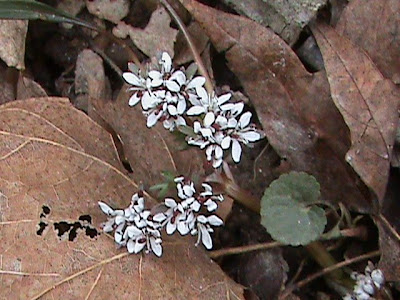
On a recent hike with some of our volunteers, we noticed one of the first wildflowers of the year blooming in the park - Salt and Pepper, also known as Harbinger of Spring. The tiny white flowers of Salt and Pepper often go unnoticed by folks out for an early spring hike, unless they know to look for them:


Take a moment to lean down and look a little closer - they may not be as showy or colorful as some of the later wildflowers, but after a long cold winter we greet them with much delight!


Unfortunately, with the warm weather comes one of the less welcome signs of spring...notice anything odd about this bunny rabbit? This is a pet, a domestic rabbit, that someone released out at the park today. As you can see, the rabbit is not camouflaged at all; it had no fear of people or other animals, and did not have a thick winter coat. With temperatures dropping tonight and plenty of predators about, the rabbit probably would not have survived the night. Luckily it was spotted by some park visitors, who took the time to notify staff and stay with the rabbit until we could get there (thank you!)

The owners who released this rabbit may have been misguided, thinking that their pet could live happily "in the wild," not realizing it would suffer either a quick death by a hungry owl or coyote, or a slow one from exposure and starvation. The rabbit will be taken to a rescue group and found a new home - something the original owners should have done. Domestic pets should never be released into the parks!


And finally, enjoy another video clip - the sounds of the Western Chorus Frogs (Pseudacris triseriata) singing from one of the ponds in Eagle Creek Park. These tiny frogs will call from now until mid-April on warm days, lay their eggs, and then the adults go back into the forest and we won't hear them again until next year:

StumbleUpon

More Bloggin' Naturalists

You might have noticed a few more names to the Contributor List of the blog. A few of my naturalist buddies have agreed to join and now we will have even more cool things to share. Dawn, Brittany and Andrea are out at Eagle Creek Park on the northwest side of town.
Frog Dawn is an expert on amphibians and reptiles and part of Frogwatch, so expect lots of cool posts on salamanders and frogs in the days ahead. Andrea is a real fungus and lichen buff. She likens the lichens! :) And Miss Brittany loves raptors and canids(wolves and coyotes). Adam is located at Holliday Park on the north-middle part of Indianapolis. He is the Assistant manager over there. I, Janet, am at Southeastway Park on the southeast side. I am really into birds and botany, and bugs, but like about anything nature related. We might have a few more join us along the way, and I will introduce them as they come on board. Welcome, everyone!StumbleUpon

Saturday, March 7, 2009

Dance of the Timberdoodle-Woodcock at Southeastway Park

When leaving work Friday night I heard a familiar call and immediately got excited. Peeeennt! Peeeent! Oh my gosh! A Woodcock!


I rushed quickly toward the call, near the side of our building. Sure enough, it kept calling away and this time I heard the wing-whir as well. The woodcock's wings make a twittering, whirry sound during its display flight. The outer three feathers on the wing, called primary feathers (there are ten primary feathers on each wing of most birds), are somewhat narrow and vibrate during the flight to cause the odd noise.


The wing of a male American Woodcock showing the three outer primary feathers.
The feathers are narrowed and produce a twittering sound during its
flight display. Drawing by David Sibley from Birds of North America Online.

Woodcocks, also known as timberdoodles, have such an unusual courtship display. The male will waddle around on the ground belting out a loud, buzzy Peeennt. The bird will suddenly spring into the air, and fly in wide ascending circles sometimes as high as 300 feet. The wings will begin to twitter near the top of its flight pattern. Next the woodcock will spiral toward the ground, performing tight acrobatic loops while uttering soft chirps. Very bizarre! The female will stand nearby watching these displays. If impressed, she will later mate with the accomplished performer.

Last September, after checking out the famous Coshocton Wood Storks, I was driving back home. It was just starting to get dark, when out in the middle of the road I saw a brown lump. I slowed way down thinking it might be a rock or big dirt clod. I finally realized it was definitely not a rock. A woodcock quickly flew to the side of the road and tried to hide down in the vegetation. Its coloration is very similar to dead leaves, so it can blend in easily with a forest floor. I rolled down my window and slowly eased up. I was able to get a few pics of it before it scurried off for better cover.

An American Woodcock pretending to be dead leaves.


Here is the same photo cropped in so you can see its amazing beak better. The beak of the American Woodcock is used to probe for worms and other goodies in the soft soil. The tip is flexible, not rigid like those of other birds. This feature allows the woodcock to probe deep into the mud, then open the bill underground to grab the earthworm or other invertebrate prey. There are also sensory nerves in the bill that allows the woodcock to locate its food. The large eyes located high and on the side of the head allow the woodcock to see 360 degrees around to help avoid predators.

American Woodcocks perform there display flights in late February and March. The best place to find would be an open field near a woods. Check these areas at dusk or right before dawn and hopefully you too will witness the amazing aerial display!

StumbleUpon

Friday, March 6, 2009

Skywatch Friday-Ft. Harrison State Park


I took this photo a couple of weeks ago at Ft. Harrison State Park on the northeast side of Indianapolis. Don Gorney and I were listening for woodcocks when I noticed the amazing sky behind us. I thought the gnarly tree looked really cool with the background of smoky blue clouds intertwined with orange and peach rays.

Check out other great photos from around the country at the Skywatch Friday site.StumbleUpon

Wednesday, March 4, 2009

Red-bellied Rocker


My brother, Charles Creamer, sent me an awesome photo of a male Red-bellied Woodpecker from his feeder. It reminded me of a post a while back from Bill Thompson of Birdwatcher's Digest about the Red-bellied Woodpecker. He said the Red-bellied Woodpecker had an awesome red mullet and a zebra-striped outfit like a rocker. I will have to agree. I could totally see this guy rocking out to some Free Bird while gobbling up tasty beetle larvae and finishing his set with a ten minute drum solo. :) I now use this description in my programs with kids. They remember the silly description and really key in on the field marks. Thanks Bill!
StumbleUpon