Do you see the creature in the tree?

Its looking at you.

Now, I am sure you see it.
This is a Black-crowned Night-Heron, Nycticorax nycticorax. A truly awesome bird. Their loud "QUUAARRKK!" drew our attention to them; there were two sitting in trees next to the river. Black-crowned Night-Herons are fairly common throughout North America, although the populations did take quite a hit in the late 1960's due to DDT. Night-herons, as the name suggests, are nocturnal and crepuscular when they feed. They will roost all hunkered down in trees during the day and apparently we had disturbed them.
Black-crowned Night-Herons are opportunistic feeders, meaning, just like some guys I know, they will eat anything that is in front of them. They prefer fish, but will also take small mammals, amphibians, other birds, reptiles, eggs, crayfish, mussels, insects, worms, leeches, carrion, plants and garbage. This feeding behavior can help with survival. If one food source is limited, they can easily switch to another source. Raccoons and oppossums are other opportunistic feeders and everyone knows how prevalent they are!
Night Ravens, another name for these secretive midnight munchers, are bioindicators. (The Greek scientific name Nycticorax means night raven.) Since Black-crowned Night- Herons are high on the food chain, if their populations start to drop, scientists receive a heads-up on contaminations or other pollution problems in their ecosystems.


 Mother Nature was played by Mary Jo Rouse. Children and their adults had to promise to love the animals, take care of the earth and then spin around two times for the magic to work. Joining her were two wood fairies, Kathleen Craig and Tunie Snyder. Alicia King played Mother Nature on Saturday night. (Photo by Adam Barnes.)
 Families were led through the forest and encountered various animals along the way. This funny frog was played by Cindy Collins. The croakster was a favorite with the kids with her snappy comebacks and quick ability to ad lib. She was training for the olympics and Michael Phelps had been giving her tips about sponsorship.
 Next visitors encountered Heidi the Hummingbird from Canada who was on a trip to Mexico. She was stopping for the night at Holliday Park. Heidi was played by Denise Stockdale. Heidi engaged all the children by asking them to dance with her.
 Lucy the poetic Lightening Bug, played by Claire Wilcher, lamented over the loss of her boy bug who ran off with, what she first thought was, a prettier lady bug. The children reminded her that she had a beautiful tail that lit up the night and that she was very special, too.
 Visitors were treated to a campfire and the Act One Children's Theater entertained everyone with pumpkin carols, well-known Christmas carols adapted to Halloween. A crowd favorite was "Pumpkin Bells." (Photo by Adam Barnes.)
 Here is the our lovely female, Mary the mantid. . She is a beautiful gray phase, with dabbled markings on her body. She blends in nicely with bark and lichens, allowing her to be camoflaged from her prey. Such a delicate little flower. Errr, ummm, well in another mantid's eye, I guess. Mantids are such interesting creatures. They look alien-like and move so methodically and deliberately when they are hunting prey. But don't let them fool you! They can be lightening fast when they are catching their prey or trying to escape a predator.


 I cropped the picture in a little closer. Here you can see the smaller yellow wings of the Carolina Mantid. Their wings reach halfway down the abdomen, while the
  Here is the dorsal or top view of the Banded Garden Spider. What a beaut! I love the distinguishing horizontal stripes across its abdomen. It reminds me of the squeaky tiger toy I had as a child. I chewed its ears off and carted the thing around with me, wherever I went.
  "Good Morning, boys and girls!!!!!" Chris Martini belted out to welcome the crowd of 425 students and 60 plus adults. Eighteen classes representing five schools visited the park yesterday.
 Michele Conyer, Outreach Naturalist, taught a session on Extirpated Animals. The children kicked off their shoes and plopped down on plush furs to enjoy a fascinating walk through time.
 Roy Ballard from Hancock County Purdue Extension taught a session on plants and how they prepare for winter. The children went on a hike and learned all about seed dispersal, leaf loss and adaptations that assure the plant's survival.
 Andrea Hopper, naturalist at Eagle Creek Park, taught a session on Reptiles and Amphibians. Here she is holding a box turtle and explaining all about its unique behaviors.

 Normally, salamanders are usually found in damp environments, like pond edges, under rocks in creeks, or under logs or rocks in moist areas of the forest. Salamanders can breathe through their skin and the moist conditions facilitate this.
 The first herp we found was a gorgeous five-lined skink. Quick and agile little booger. The
  Our next herp was very cranky garter snake. He did not like being a participant in herp day one bit and wanted no part of it. Poor Scott, the finder, was bitten a few times and musked. (Garter snakes have glands that produce a pretty raunchy odor, which they use as a defense.) Luckily, garter snakes have very small teeth. (Photo by John Howard.)
 My favorite stop was the next one, yielding lots of good plants, bugs and, of course, herps. Our best finds were three Green Salamanders, Aneides aeneus. A real rarity here in Indiana and Ohio, Green Salamanders
 At the same stop, in a nearby creek we found all kinds of salamanders. Dusky Salamander, Southern Two-lined Salamander and this critter. This Red Spotted Newt was marching right along, unafraid of anyone. And with good reason.
  Another stop later in the day yielded some other great finds. My first look at a Northern Red-bellied Snake, Storeria occipitomaculata . What a beaut! For you word nerds, occiput means "back of the head" and macula means "spot". If you notice, it has a small spot on its neck, right near the back of the head. John Howard is my lovely hand model.
 Even though this is not a herp I was still excited to see it. I hadn't seen a Black Widow Spider for over 20 years. We had a few juveniles earlier in the day, but under a rock was this nice adult specimen. I like to pick up spiders, but this one I stayed clear of.
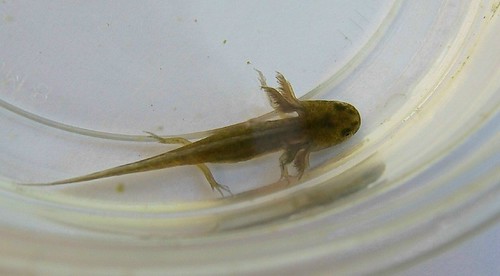
 Our last stop of the day yielded a Marbled Salamander, Ambystoma opacum, on eggs. The brown roly-poly objects are the eggs. Marbled Salamanders breed and lay eggs in the fall. The female will stay close to guard the eggs. Sometimes, if there is plenty of rain, the eggs will hatch in the fall. In times of drought, they will wait until spring to hatch. Breeding in the fall and hatching in autumn or early spring give the larvae a head start. Since they will be bigger than all the other salamander larvae swimming in the