Monday, June 6, 2011

Grassland Birds at the Airport

I was driving home from Illinois Sunday evening, following I-70, and managed to overshoot my exit by quite a bit. I saw the exit for the Mt. Comfort Airport (Now called the Indianapolis Regional Airport) and remembered a post on IN-bird from Don Gorney about Upland Sandpipers a few days ago. So, to take great advantage of a unfortunate mistake, I decided to give Don a ring and ask him where I was most likely to see them. I am so glad I missed my exit!


Since I was at an airport, even though it was a small one, I was a bit nervous about taking photos. And the birds were a bit too far away to get anything worth showing anyway, so I am going to use good old Wikipedia for the photos. Hope you all don't mind too much :)

Upland Sandpiper, photo from Wikipedia

So here is the star of the show, the Upland Sandpiper, Bartramia longicauda.  I was able to get great looks at three of them, all out in the open at the same time. I also was treated to their wolf whistle call, "Wheet-woo". It always makes me laugh. :) Upland Sandpiper is a state-endangered bird for Indiana.

Savannah Sparrow, photo from Wikipedia

I soon heard the "Take it easy" song of the Savannah Sparrow. Such a pretty sparrow, with its pink legs, yellow lores and speckled breast. I had one right behind my car, not more than 8 feet away. Beautiful! I found a few more during my visit.

Eastern Meadowlark, photo from Wikipedia 

I found about 10 Eastern Meadowlarks scattered about the property. Some were perching on fences, others were flying about and quickly disappearing into the grass. Their brilliant yellow chest with the deep black "V" really stood out in the evening sun.
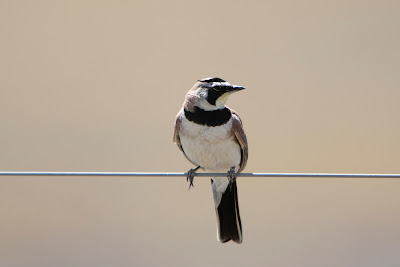
Horned Lark, photo from Wikipedia

There were two Horned Larks taking a dust bath on the road. They were preening their feathers and tossing about the dust from the road. Many birds use dust baths to help reduce avian parasites, like lice.

Dickcissel, photo from Wikipedia

I heard a sound behind me and turned to see a favorite grassland bird. "Dic-dic-sizzle, sizzle" called a handsome male Dickcissel which was perched up on the fence. I watched him sing for a long while, happily soaking it all in.

Bobolink, photo from Wikipedia

A few birds flew overhead and called. Bobolinks! I love their bubbly call, like a miniature R2D2 from Star Wars. "Spink-spank-spink"! They dove into the grass and disappeared from sight.


I love when I make a mistake and end up with a good result. What a nice ending to the weekend!

StumbleUpon

Friday, June 3, 2011

Water Day-Baby Cricket Frog

Today was water day for our preschool Wiggle Worms camp. We tromped out to the pond and used dip nets to catch all kinds of critters.

This critter is a dragonfly nymph, the aquatic stage of the dragonfly. Earlier in the day, Linsi read the story Dazzling Dragonflies by Linda Glaser to the campers. This is an excellent book for young children on the dragonfly life cycle. Since they were already prepared by the book, they were really excited to catch these somewhat creepy-looking insects. Many were excitedly screaming " I caught a baby dragonfly!"

This lizard-like creature is a damselfly nymph. Damselflies are in the same order as dragonflies. The abdomens of adult damselflies are more slender than most dragonflies and they hold their wings folded over their backs while dragonflies hold them out to the sides of their body.

This critter is a young crayfish, or crawdad, if you will. Many of the kids thought they were lobsters, which they do resemble. Even though it was too tiny to do any harm, it was a feisty little thing!

We even found part of a fascinating plant. This is Common Bladderwort, a carnivorous plant. The bladders, the dark, round objects in the photo, trap tiny pond creatures and produce enzymes to digest the prey.

Blanchard's Cricket Frog, Acris crepitans blanchardi, a sub-species of the Northern Cricket Frog, posed nicely for a photo. I think its face kinda looks like Kermit, if Kermit was brown. These frogs are masters of camouflage, as you can see on another post. Also, Nothern Cricket Frogs are a Species of Special Concern for Indiana, which means their numbers are declining, so they are on a watch list. I am very pleased they like our pond!

The big excitement for the day was catching these little guys! A young cricket frog, smaller than my thumbnail! Wow!

And then we caught this one. A cricket frog that still had its tail! It was still going through metamorphosis and was even smaller than the last one! It was such a great day out at the pond, exploring and discovering many, many cool things!StumbleUpon

Tuesday, May 31, 2011

Red-winged Blackbird Nest

Each spring we look forward to the return of the Red-winged Blackbirds, Agelaius phoeniceus, to our wetland. The males usually show up in early March, singing their "Con-cur-ee" song, announcing to all the ladies that they have aquired some prime real estate for nesting.

Above is the male Red-winged Blackbird, a real looker with his jet black feathers accented with scarlet epaulettes trimmed in yellow.
This is the female. She is also a beautiful bird, but very camouflaged. This is so she can blend in with the nest and not be noticed by predators. She builds a nest from grasses and reeds and tucks it down among the cattails. It is hard to spot the nest at first, but by careful observation, one can determine where she has hidden it.
The nest is almost dead center in this photo. I don't expect you to find it, but wanted to show how well they can hide the nest. Many times I would go out to check on the nest and not find it right away, even though I knew exactly where it was. 

And here is the nest, closeup with the baby Red-winged Blackbirds. They were just starting to get their feathers. When they get their full set of feathers, they will at first all look like the female.  The young males will eventually get an orangish patch on their shoulder. Hopefully, they will all make it to adulthood and we will enjoy their song for years to come. 

StumbleUpon

Monday, May 30, 2011

Wood Poppy

Our Wood Poppies, Stylophorum diphyllum, at Southeastway are almost finished blooming. Just a few blossoms are left, hanging on to the last days of spring. Such a striking yellow plant, I eagerly look forward each spring for them to bloom and am somewhat sad when they are finished for the season.


They are called poppies because their seed capsule, when ripe, will burst open or pop when touched expelling the seeds across the ground. Hopefully, they will produce many more of these beautiful flowers to enjoy next year!StumbleUpon

Friday, May 27, 2011

Some Cool Finds at the Park

Another great day with lots of cool finds in the park. Today, Miranda and I were visited by the first graders from Indianapolis Public School 90. These energetic students were eager to learn and had very sharp eyes! One of our finds is in the following pictures. See if you can spot it!


Okay, I will give you a hint, it is right in the middle of the photo below, circled in red. :)

 Here is a closer shot, you might be able to make it out in the next photo.

Now I am quite confident you will be able to see it in this next photo. Don't feel bad if you couldn't spot it in the other photos. I couldn't find it at first when Miranda showed it to me.


Mama robin sitting on her nest! She was well-camouflaged. Most of the children were able to see the male robin busily harvesting juicy worms from the dirt in the turf grass below the nest.

One of the students spied this male Luna Moth, Actias luna, fluttering its wings in this Spicebush shrub. This was a special treat because you don't get to see Luna Moths everyday. Seeing the moth was many of the students favorite part of the trip. You can see a better shot of its wings in this post.


Here is a closer view of the moth. The feathery antennae of the male help it locate the female by detecting pheromones she emits from her abdomen. He can pick up her scent from miles away. The Luna Moths have a short life-cycle, and only live up to seven days. Because they live for such a short time, they do not have mouthparts and do not feed. 

Since we have had a few storms in the last couple of days, some of the American Tulip Trees, Liriodendron tulipifera, had lost a few of their blossoms. The children were fascinated with the beautiful flowers. You can see the leaf of the tree in this photo, which I think looks a little like a cat's face. (Use your imagination, people. :) )The ears are the two pointed lobes on the top part of the leaf and the two lobes on the side of the leaf resemble the cat's whiskers.


This is a closeup of one of my favorite flowers with its pale yellow petals accented with brilliant orange. The trees are so tall and stately and produce tons of gorgeous blossoms. And the scientific name is very fitting-Liriodendron means "lily tree".


Another great day out! Look for Luna Moths, Tulip Tree blossoms and robin nests on your outdoor adventures this weekend!
StumbleUpon

Thursday, May 26, 2011

Baby Painted Turtle

Each day brings something new, especially when you work in a park. Today, one of our maintenance staff, Adam Helton, brought a newly hatched Painted Turtle, Chrysemys picta, into my office. He rescued it from a puddle, where it was happily swimming around. Unfortunately, the puddle was in the path of traffic and only a few minutes after Adam had scooped up the turtle, a vehicle drove through the puddle. The little turtle was very lucky that Adam had stopped by and took the time to rescue it. Thank you so much, Adam!

 I took the turtle to our wetland area, where it could get all of its needs, yet not worry about big fish possibly snacking on it. It seemed quite happy in its new home.

 Here is a shot of its red belly. The Painted Turtle gets its name from its bright yellow and red markings.


I titled this photo "Lady, you are on my last nerve." Apparently, even turtles do not care for paparazzi. As you can see it is not much bigger that a penny, and probably just hatched in the last day or so.

Adam also showed me an adult Painted Turtle that had been hit by a car. This is the time of year when female turtles will travel to find a suitable place to lay their eggs. Unfortunately, she was hit by a car before she made it to her destination. When she was hit, she expelled seven eggs. Five were broken, but two were still in perfect shape. I took them to the wetland area where I had released the baby turtle and covered all but the top of the eggs with dirt. Hopefully, they will hatch, and we will have a few more Painted Turtles to look forward to.StumbleUpon

Saturday, May 21, 2011

Oven Bird Nest

Over the weekend, I participated in the Ohio Heritage Naturalist hike at Cave Lake in Pike County near Latham, Ohio. While there, Marjie Becus found an Oven Bird nest.


Oven Bird photo from Wikipedia.

Oven Birds, Seiurus aurocapillus, are small migratory songbirds in the warbler family. They are colored olive-brown with a white breast streaked with dark brown markings. The crown of its head is adorned with an orange streak that is bordered with dark brown. This latin name aurocapillus alludes to the orange crown and means "golden hair".

The Oven Bird is a warbler that nests on the ground. The common name of the bird comes from its unique nest that resembles a old-fashioned brick oven.The bird constructs the nest with leaves and grasses and makes a roof to protect the eggs and conceal it from predators. The female bird will quietly sit on the nest, motionless. Marjie almost stepped on the nest before the female flushed. The male is quite the opposite. His persistent calls of "TEA-cher, TEA-cher, TEA-cher will loudly ring throughout the forest.


Here is a closer view of the speckled eggs inside the nest. The Oven Bird will lay 3-6 cream colored eggs speckled with brown spots. This was the first Oven Bird nest I had encountered, so I was quite fascinated with its artful construction and perfect camouflage. Amazing!
StumbleUpon